When brands and retailers plan a merchandising project, one common question comes up early: should you choose a cardboard display or a plastic display? Both options are used in retail, but they are designed for different priorities. The right choice depends on your product type, campaign length, budget, branding needs, shipping plan, and store environment.
For many promotional projects, a custom cardboard display offers stronger flexibility, faster customization, and better cost efficiency. Plastic displays may still be useful in some long-term retail environments, but they are not always the best answer for modern promotional programs. In this guide, we compare cardboard displays and plastic displays from a buyer’s perspective so you can choose the right solution for your project.
Quick Answer: Which One Is Better?
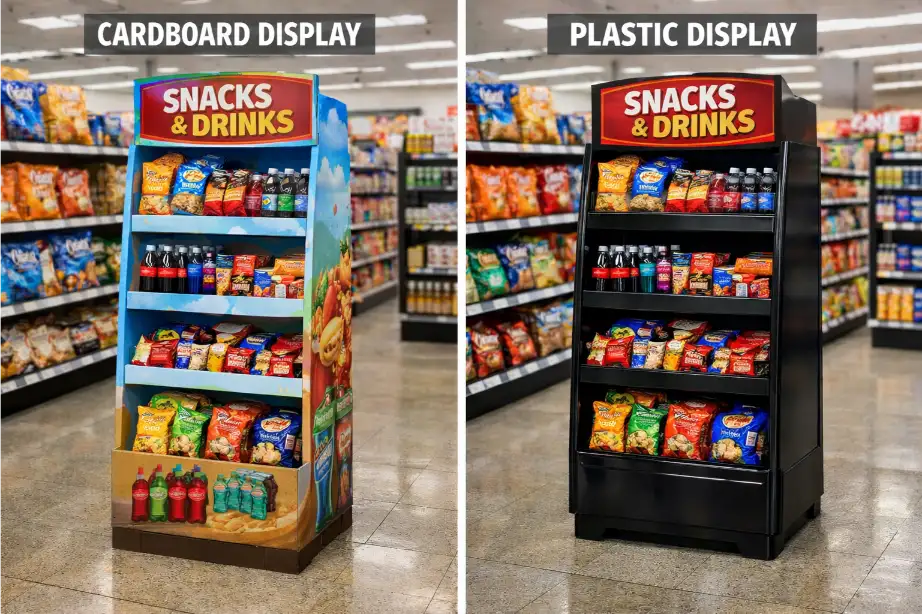
There is no universal answer for every project, but for most short-term and medium-term retail promotions, cardboard displays are usually the better choice because they are more cost-effective, easier to customize, faster to produce, and more efficient for shipping. Plastic displays may be suitable for some long-term permanent retail fixtures, but they usually require higher upfront cost and less flexibility.
If your project focuses on retail promotion, seasonal campaigns, product launches, or export efficiency, cardboard displays are often the more practical option.
What Is the Main Difference Between Cardboard and Plastic Displays?
The biggest difference is purpose. Cardboard displays are usually designed for promotional flexibility, visual branding, and efficient retail rollout. Plastic displays are more often used for longer-term semi-permanent or permanent store fixtures. Cardboard is easier to print and customize, while plastic is generally associated with longer material life but also higher tooling cost and less flexibility for campaign changes.
That means the better question is not “Which material is stronger?” but “Which material fits the real business goal of this retail project?”
Comparison Table: Cardboard Display vs Plastic Display
| Factor | Cardboard Display | Plastic Display |
|---|---|---|
| Upfront Cost | Usually lower | Usually higher |
| Customization Speed | Fast | Slower |
| Graphic Branding | Excellent for full printing | Usually more limited |
| Shipping Efficiency | Very good with flat-pack packing | Often bulkier |
| Retail Campaign Flexibility | High | Lower |
| Long-Term Reuse | Medium | Higher |
| Sustainability Perception | Generally stronger | Often weaker |
When Cardboard Displays Are the Better Choice
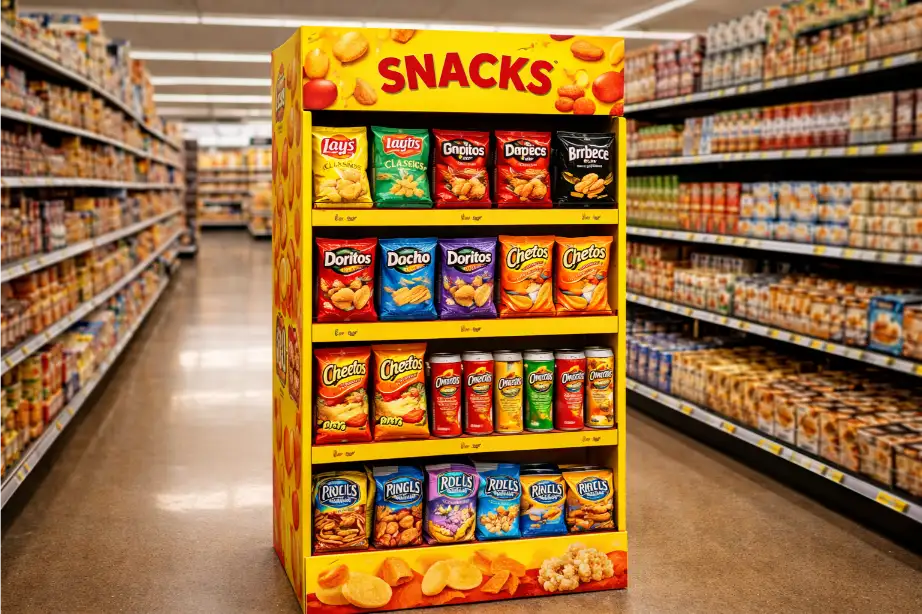
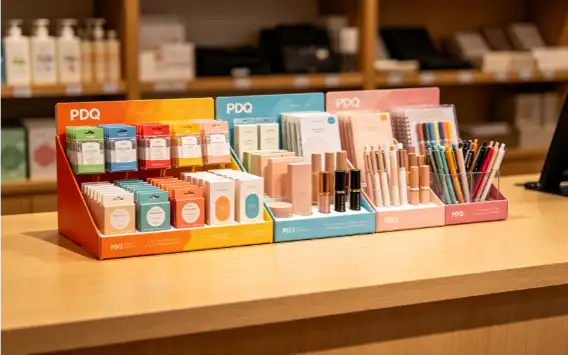
Cardboard displays are often the better option when the project needs strong branding, lower cost, faster production, and campaign flexibility. They are especially suitable for seasonal promotions, new product launches, checkout programs, supermarket campaigns, cosmetics, snacks, beverages, pet products, and many other retail categories.
One major advantage is how easily cardboard displays can be customized. Structure, size, printing, header shape, shelving, and promotional messaging can all be adjusted based on the product and campaign. Buyers who need quick development cycles usually prefer cardboard because it supports faster changes and more efficient production planning.
If you are comparing project cost and order planning, you can also review our custom cardboard display cost guide and our MOQ guide.

When Plastic Displays May Make Sense
Plastic displays may make sense for certain long-term store fixtures where the same display will stay in use for a long time and the retailer does not need frequent campaign changes. In those situations, buyers may accept higher initial investment in exchange for longer material life.
However, that does not automatically mean plastic is the better business choice. For many promotional programs, the higher cost, heavier shipping profile, and lower design flexibility of plastic displays can make them less attractive than cardboard. Buyers should carefully compare not just durability, but also speed, branding, and total campaign cost.
Which One Is Better for Retail Promotion?
For most retail promotions, cardboard displays are usually better. Promotional campaigns often need strong graphics, short development time, manageable MOQ, and easier shipping. Cardboard performs well in all of these areas. A display created for a 4-week, 8-week, or seasonal promotion usually does not need to behave like a permanent store fixture. It needs to look strong, hold the products safely, and support sales efficiently during the campaign period.
This is where cardboard displays offer the best balance. They provide visual impact while keeping the project commercially practical.
Which One Is Better for Branding and Graphics?
Cardboard displays are generally stronger in branding because the material is much better suited to full-surface printing. Brands can use large graphics, promotional text, seasonal themes, and stronger visual storytelling more easily on cardboard. This makes cardboard displays especially effective for fast-moving retail environments where visual communication matters.
Plastic displays can still carry branding, but they often do not offer the same level of printing flexibility without more specialized processes. For buyers who want the display itself to act as a visual campaign tool, cardboard is usually the better choice.
For a closer look at print surface decisions, you can also read our guide on printing and finishing options for retail cardboard displays.
Which One Is Better for Shipping and Export?
For export projects, cardboard displays usually have a strong advantage because they can often be packed flat. Flat-pack shipping reduces freight cost, improves container efficiency, and makes warehouse storage easier. This matters a lot for international buyers who need to control landed cost as well as production cost.
Plastic displays are often bulkier and may take up more shipping space depending on the structure. That means even if the display itself is durable, the total logistics cost may be much higher.
If export handling is part of your project, our cardboard display export packaging guide explains why flat-pack shipping often gives cardboard an important advantage.

What About Durability and Load Capacity?
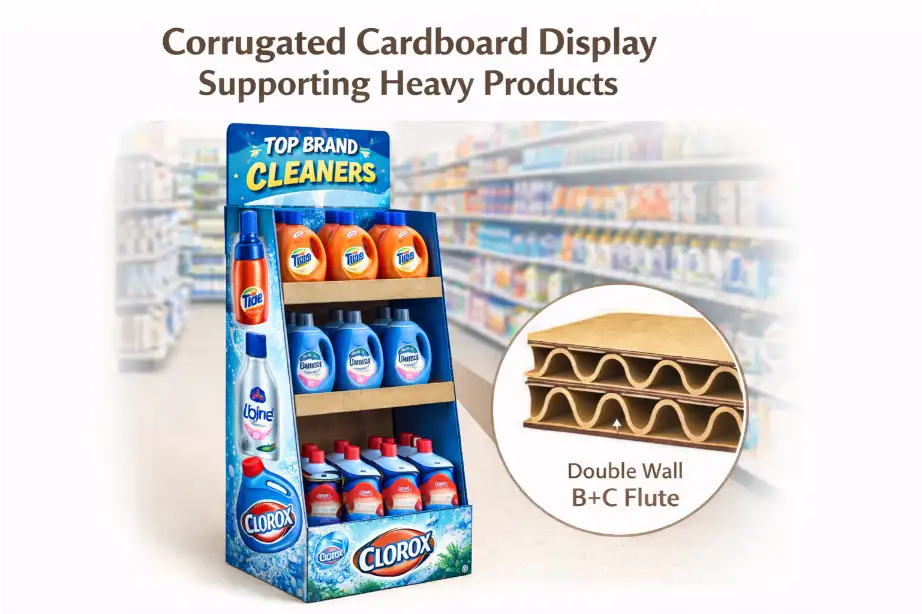
Many buyers assume plastic is always better because it sounds stronger. In reality, the answer depends on the actual project. A well-designed cardboard display with the right corrugated grade, shelf support, and load distribution can perform very well in retail. For many products, especially promotional goods, snacks, cosmetics, accessories, and even many beverage programs, cardboard is more than sufficient when designed correctly.
The key is not simply the material name. It is whether the display structure has been designed for the product weight and retail conditions. Buyers who need more confidence in board strength can also review our article on corrugated grades for displays.
Which One Is More Sustainable?
Many brands today also consider how display material affects sustainability messaging. Cardboard usually aligns more naturally with recyclable, paper-based retail communication. This can strengthen the brand image of companies that want to reduce plastic-heavy presentation in-store. While sustainability claims should always be discussed carefully and honestly, cardboard is often viewed more positively in retail programs where environmental perception matters.
Buyer Checklist Before Choosing Cardboard or Plastic
- How long will the display stay in-store?
- Does the project need fast customization?
- How important is printed branding?
- Is export shipping part of the project?
- Does the campaign need lower upfront cost?
- Will the display be changed seasonally or frequently?
- What is the real product weight and load requirement?
Useful External References
If you are comparing material logic for retail displays, it also helps to understand corrugated fundamentals. The Fibre Box Association overview of corrugated is a useful starting point. For structure terminology in corrugated packaging and display discussion, the FEFCO code reference is also useful.
Conclusion
So, cardboard display vs plastic display: which one is better for retail? For most promotional and campaign-driven projects, cardboard displays are usually the better option because they offer stronger branding, faster customization, better shipping efficiency, and lower overall project cost. Plastic displays may still be useful for some long-term fixture programs, but they are not automatically the best solution for every retail need.
If you are comparing display materials for your next project and want advice based on your actual product and campaign plan, feel free to contact us.
FAQ
Are cardboard displays cheaper than plastic displays?
In many projects, yes. Cardboard displays usually have a lower upfront cost and better shipping efficiency.
Are plastic displays stronger than cardboard displays?
Plastic may offer longer material life in some cases, but a properly designed cardboard display can still provide strong and reliable retail performance.
Which display is better for promotions?
Cardboard displays are usually better for promotions because they are easier to customize, faster to produce, and more efficient for campaign-based retail programs.
Which display is better for export shipping?
Cardboard displays are often better for export because flat-pack packing improves freight efficiency and storage practicality.
Can cardboard displays hold heavy products?
Yes, if the structure is designed correctly and the right corrugated grade is used for the product load.
Which one offers better branding?
Cardboard displays usually offer better full-surface printing and stronger promotional graphics for retail branding.